
November 18, 2026 · 8-min read
How to Word a Bereavement Leave Request: Email and Text Templates
You do not need long sentences. You need four facts, a calm tone and a message you can send in a minute.

A bereavement leave request needs only four facts: who died (your relationship to them), the day your leave starts, when you expect to be back, and who is covering anything urgent. Two or three plain sentences are enough, and you can send them by email or text. Below are copy-ready templates for a parent or close family member, a more distant relative, a friend, and a funeral you need to travel for.
When someone has died, even a short message to your manager can feel impossible to write. These templates are here to take the wording off your plate. Change the brackets, trim anything that doesn't fit, and send.
What should a bereavement leave request include?
Include only what your employer needs to plan around your absence:
- Who died. "My mother," "my grandfather" or "a close friend" is enough.
- Your start date. Today, tomorrow or the date of the funeral.
- Your expected return. A date if you know it, or a note that you will confirm it.
- Cover for urgent work. One line about what is handled and who to ask.
- How to reach you. Say whether you can be reached for urgent questions or not.
- How the time is recorded. If you are unsure whether it will count as bereavement leave, vacation or unpaid leave, you can ask in one sentence.
Rules about paid and unpaid leave differ by country, state and employer, so your employment agreement, staff handbook or HR team is the place to confirm what applies to you. It is fine to ask them directly.
How much detail do I need to give?
Very little. Your employer needs to know that someone has died and what time off you need. You do not need to share the cause of death, the circumstances, or anything about the family that feels private. If you would like some support from your workplace, you can say so, but you never have to.
If a manager asks a question you don't want to answer, you can say, "I'd rather not go into details right now, but thank you for asking." That is a complete answer.
Email template: a parent, spouse, child or sibling
Subject: Bereavement leave request, [Your name]
Hi [Manager's name],
I'm very sorry to tell you that my [mother / father / husband / wife / partner / son / daughter / brother / sister] died on [date]. I would like to take bereavement leave from [start date] and expect to return on [date]. I will confirm the dates as soon as the service is arranged.
Before I go, I'll make sure [urgent task] is handled by [colleague's name]. [I will not be checking email, so please contact [colleague] for anything urgent. / I can be reached by text for anything urgent.]
Could you let me know how this time will be recorded? Thank you for your understanding.
[Your name]
This is the fullest version. If it feels like too much, cut it back to the first paragraph.
Email template: a grandparent, aunt, uncle, cousin or in-law
Subject: Time off for a family funeral
Hi [Manager's name],
My [grandmother / grandfather / aunt / uncle / cousin / father-in-law / mother-in-law] died on [date], and the funeral is on [date]. I would like to take [day(s) and date(s)] off to attend and to be with my family.
[Colleague's name] has agreed to cover [task] while I'm away. Please let me know if you need anything else from me before then.
Thank you, [Your name]
If you are close to your extended family, you may want to ask for more than the funeral day. It is reasonable to ask for the days you actually need.
Email template: a close friend
Subject: Request for a day off to attend a funeral
Hi [Manager's name],
A close friend of mine died on [date], and the funeral is on [date]. I would like to take [date] off to attend.
If bereavement leave only covers family, I'm happy to use [a vacation day / a personal day / unpaid time] instead. I will make sure [urgent task] is covered before I leave.
Thank you, [Your name]
Offering another way to record the time makes it easy for your manager to say yes.
Email template: a funeral you have to travel for
Subject: Bereavement leave and travel, [start date] to [return date]
Hi [Manager's name],
My [relationship] died on [date] in [city or country], and the funeral is on [date]. I need to travel to [place] to attend and to be with my family.
I would like to request leave from [departure date] to [expected return date], which includes travel time each way. I am still confirming flights, so these dates may move by a day or two. I will update you as soon as they are booked.
[Colleague's name] will cover [task] while I'm away. [I will have limited access to email, so please text me only for anything urgent.]
Thank you for your understanding.
[Your name]
Travel often takes longer than the funeral itself, so include the days you will spend getting there and back. If you are working out the logistics from a distance, our guides to planning a funeral when you live far away and planning a funeral when someone dies overseas cover the practical side.
Some employers also ask for a funeral notice, a program or a short note afterwards. If yours does, you can usually provide it once you are back, and it is fine to ask what they need.
Text message templates for first notice
When you cannot call and an email feels like too much, a short text is a good first step. Then follow with a brief email so the dates are in writing.
Immediate family, same day:
Hi [Name], I'm sorry to text like this. My [relationship] died this morning, and I won't be in today. I'll email you my dates once I know more. Could you let [colleague] know about [urgent item]?
Late at night:
Hi [Name], I've just had very sad news: my [relationship] has died. I won't be in tomorrow. I'll call or email you when I know more.
A relative's funeral:
Hi [Name], my [relationship] has died and the funeral is on [date]. I'd like to take [date(s)] off. I'll email the details and sort out a handover before then.
Travelling for a funeral:
Hi [Name], my [relationship] died and I need to travel to [place] for the funeral. I'll email my dates once my flights are booked. Could you cover [item] in the meantime?
What if I don't know the dates yet?
That is very common. Funerals can take days to arrange, and you may not know when you can return. Give first notice now and promise an update, not an answer:
"I expect to be out for the rest of this week. I'll send you my return date as soon as the service is arranged."
You are not locked in. Updating your manager later is normal and expected. If you need more time than you first asked for, a short message is enough: "I need a few more days. I'll confirm my return date on [day]."
For how many days people commonly ask for, and what to say if your employer doesn't offer paid leave, see our guide to how to ask for time off work for a funeral, with a sample email.
How do I follow up when I get back?
A short note on your first day back closes the loop and sets a gentle tone for the days ahead. You can send it by email or say it in person.
Hi [Manager's name],
Thank you for the time and for covering while I was away. I'm back today. I'm still finding my feet, so I'd appreciate 15 minutes this week to catch up on what changed while I was out.
Thank you again, [Your name]
Some other small things that help:
- Set an auto-reply before you leave. For example: "I am out of the office due to a family loss and will reply when I return. For anything urgent, please contact [colleague] at [contact]."
- Decide on one line for colleagues. "Thank you, I appreciate it. I'd rather not talk about it much today" is kind and honest. Our guide to what to say when someone asks how you're doing after a death has more wording for this.
- Ask for a lighter first week if it would help. A short, specific request, such as "Could I keep my first week to my regular tasks only?", is easier to say yes to than a general "I need support."
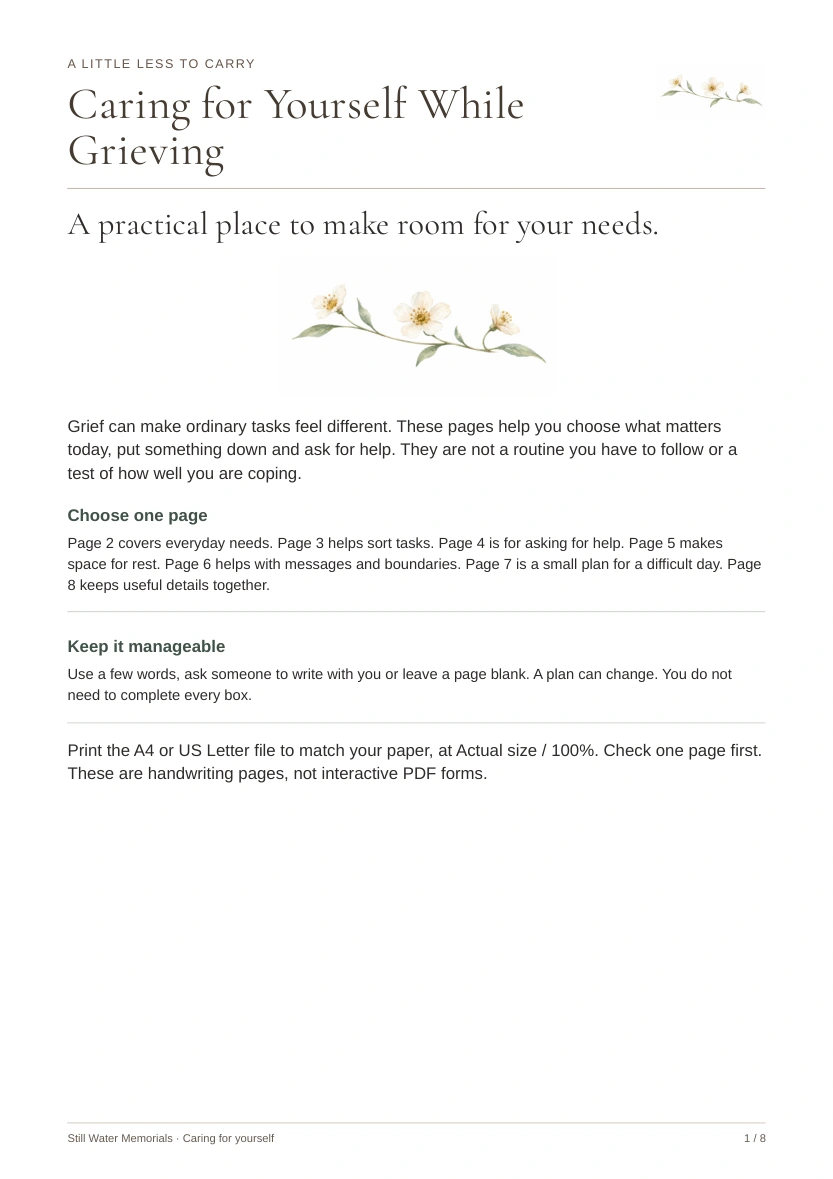
Going back to work can be harder than leaving it. If you would like a simple place to write down what you need, who you can ask for help and where you need rest, Stillwater's Caring for Yourself While Grieving pages are made for that.
A short list before you press send
- Does the message say who died, when you start, and when you expect to return?
- Does it say who is covering what is urgent?
- Have you left out the details you don't want to share? That is allowed.
- Do you have a copy of the message for your own records?
Then send it, close the laptop and let the people around you carry some of the load.
A printable to help
Frequently asked questions
- How do you word a bereavement leave request?
- Say who died (your relationship to them), the date you will start your leave, when you expect to return and who is covering your urgent work. Two or three sentences are enough. You do not need to explain the cause of death or apologize for needing time.
- Is it okay to ask for bereavement leave by text message?
- Yes, a short text is a reasonable way to give first notice, especially at night or when you cannot face a phone call. Follow it with a brief email so your employer has the dates in writing.
- Do I have to tell my employer how the person died?
- No. Your relationship to the person and the dates you need are enough. If you are asked for more, you can say, "I'd rather not go into details right now, but thank you for asking."
- What do I write if I do not know the funeral date yet?
- Give first notice now and say you will confirm the dates once the service is arranged. For example: "I expect to be out for the rest of this week and will send my return date as soon as I know it."
- Can I ask for leave to attend a funeral for a friend?
- You can ask. Some employers only count relatives for bereavement leave, so it helps to offer another option in the same message, such as a vacation day, personal day or unpaid time.
- Should I send a message when I return to work?
- A short note on your first day back is a kind way to close the loop. Thank your manager for the cover, say you are back, and ask for a brief catch-up on what changed while you were away.
- bereavement leave
- bereavement leave email
- workplace
- funeral planning
- grief support
Related reading
- How to Plan a Funeral When You Can't Afford to Take Time Off WorkA realistic guide to planning a funeral while still working full time, with a compressed timeline and tasks you can do on breaks or in the evening.
- How to Choose Funeral Readings From the Bible When You Don't Know Where to StartA simple guide to choosing bible verses for funeral service readings, with examples by situation and tips for reading them aloud.
- How to Plan a Funeral When Someone Dies OverseasWhat to do when someone dies overseas: how to repatriate remains, handle paperwork, and plan a service from a distance.