
November 23, 2026 · 7-min read
How to Write a Funeral Program When There Are Two Families
When a family has two branches, the program can either smooth the day or reopen old wounds. Here is how to get the wording right.
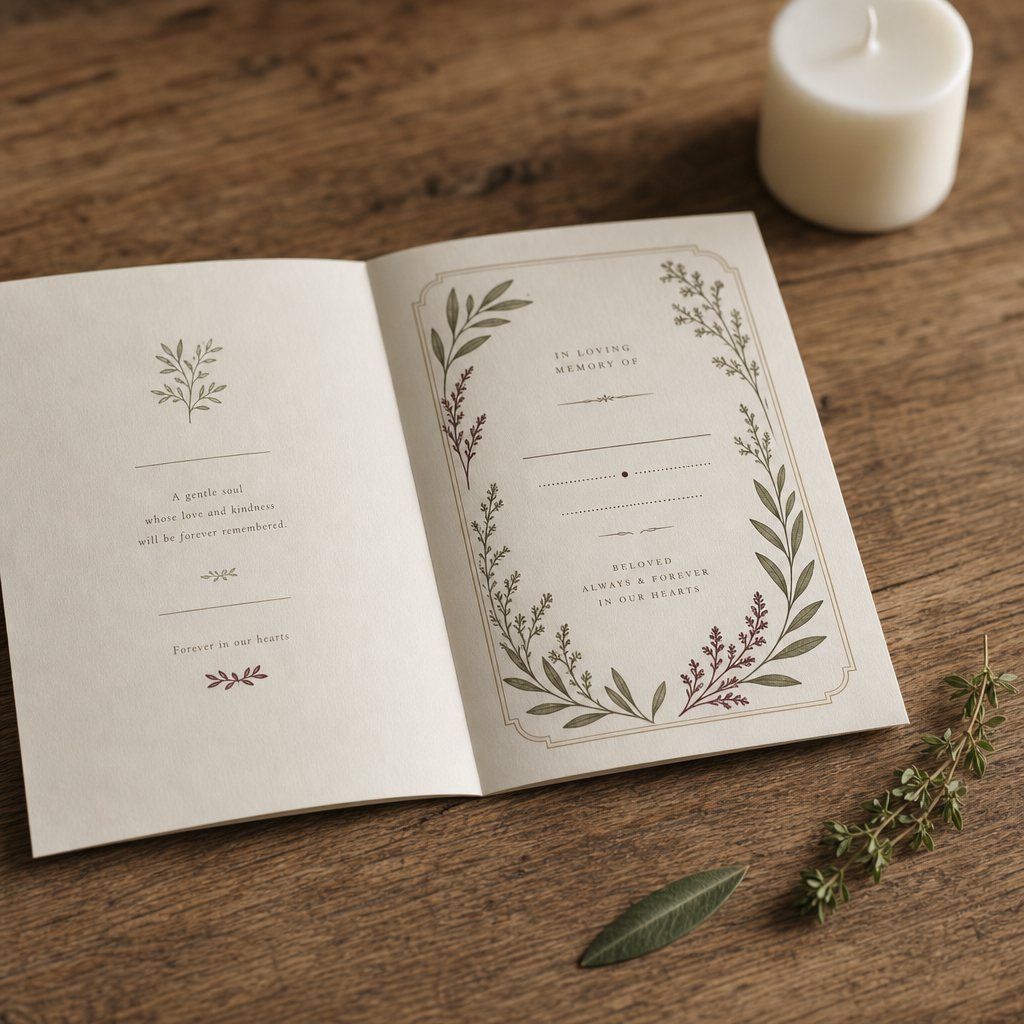
If a family has two branches, the simplest and fairest approach is to group people by relationship, not by which marriage or household they belong to, and to list every child together without labeling who is a stepchild. Getting funeral program wording right for a blended family is less about finding perfect words and more about choosing a structure that treats everyone the same way.
This is one of the harder parts of planning a service. You are grieving, and you also have to make decisions that touch old wounds between people who may not love each other. The good news is that there are a few workable templates that most blended families can live with.
Why is this part so hard to get right?
A funeral program lists names in print, for everyone to see, at the one moment a family is most sensitive. Old hurts from divorce, remarriage, or custody arrangements can resurface fast when someone feels left out or ranked below someone else.
There is also no universal etiquette rule here. Different families, faiths, and regions handle blended family listings differently, which means you cannot simply copy a template from a stranger's program. You have to make a judgment call that fits this specific family.
The goal is not to make the wording "correct." It is to make it fair enough that nobody reading it feels erased.
What's the fairest way to list two sets of children?
List all the children together, in one group, usually by birth order or age, without separating biological children from stepchildren. Use a single heading like "children" or "sons and daughters."
Example wording:
Survived by his children, Sarah Michaels, David Michaels, and Rachel Thompson.
Notice there is no mention of which child came from which marriage. That detail is not something the program needs to explain, and leaving it out tends to lower tension rather than raise it.
If a stepchild was raised by the deceased from a young age and considers them a parent, they generally belong in this same list. If a stepchild had a more distant relationship, some families choose to acknowledge them separately, lower in the program, such as:
Also remembered fondly by his stepchildren, Mark and Jenny Collins.
Both approaches are acceptable. What matters is applying the same logic consistently, rather than deciding case by case based on who asked loudest.

How do you handle a current spouse and an ex-spouse?
A current spouse is almost always listed first, under "survived by," as the primary spouse. An ex-spouse is a judgment call that depends on the relationship and how long ago the divorce happened.
A few common patterns:
- Current spouse only. Most common when the marriage ended years before the death and there are no shared minor children who want the other parent named.
- Current spouse plus a line for the other parent of the children. Something like: "He is also remembered by Linda Carter, mother of his children." This avoids the word "ex-spouse" entirely while still acknowledging the relationship for the children's sake.
- No mention of the ex-spouse at all. Appropriate when the divorce was difficult, recent, or when the current spouse and family prefer not to include them. The children can still be listed under their own names without needing their other parent named.
If children from the first marriage feel strongly about including their other living parent, it is worth honoring that request where possible. It costs little and can prevent lasting resentment.
What about two sets of grandchildren or parents?
Grandchildren are almost always grouped together by name, in one list, regardless of which parent or stepparent they descend from. There is rarely a reason to separate them.
Parents-in-law and extended family are trickier only when both sides want prominent placement. A workable rule: list immediate family first (spouse, children, grandchildren, siblings), then any additional family members the deceased was close to, named simply and without hierarchy.
If both a current mother-in-law and a former one were close to the deceased, you can list both under a general "also survived by" line without specifying which marriage connects them.
Who should make the final wording decisions?
One person should hold the pen, even if several people offer input. Usually this is the spouse, or the oldest adult child if there is no spouse, or whoever is organizing the service.
Steps that help:
- Draft the wording first, privately, based on the fairness principles above.
- Share the draft with both sides before printing, giving everyone a chance to flag a concern.
- Make small adjustments where reasonable, but do not promise to satisfy every request.
- Finalize the wording yourself and move forward. A funeral program has a deadline; family consensus does not always arrive on time.
If disagreements are running deeper than wording, including who gets to speak at the service or sit in the front row, that is a separate and larger conversation. Our guide on what to do when family disagrees about funeral arrangements covers how to navigate that without the day falling apart.

What else should the program include?
Beyond the family listing, the rest of the program can stay simple and standard. A typical structure includes:
- Full name, dates of birth and death
- A photo
- Order of service (music, readings, eulogy, closing words)
- A short life summary or obituary
- The "survived by" section discussed above
- Burial or reception details, if applicable
If you want a full walk-through of every section with sample wording, see our funeral program wording examples for every section. It covers the parts of the program that have nothing to do with family structure, so you are not starting from a blank page.
A gentle last word
There is no version of this wording that will feel completely comfortable to every person in a blended family. That is not a failure on your part. It is simply the nature of grief meeting a complicated family tree at the same time.
Aim for consistency and plain language over trying to explain every relationship in print. A program that quietly treats everyone with the same respect will do more good than one that tries to account for every detail of who belonged to whom.
If you are still choosing a format, our Christian Order of Service Funeral Program template is built with a simple, flexible family-listing section that can be adapted for exactly this situation, with room to add or remove names without redesigning the layout. You can also browse the full shop if you are looking for a program style that better matches the service you are planning.
Frequently asked questions
- Should an ex-spouse be listed on a funeral program?
- There is no fixed rule. If the ex-spouse was a parent to the deceased's children, many families include them under a line like survived by, especially if the children want their other parent acknowledged. If the divorce was recent or contentious, it is also acceptable to leave them off and let the children represent that side of the family themselves.
- How do you list stepchildren on a funeral program without saying step?
- The simplest approach is to list all children together under one heading, such as children or sons and daughters, without labeling anyone as a stepchild. This keeps the wording warm and avoids ranking family members by legal status.
- What if the two families cannot agree on the wording?
- Pick one person, often the closest surviving spouse or oldest child, to make the final call and say so plainly to both sides. A program cannot please everyone, but it can be fair, and fairness is the standard to aim for, not unanimous agreement.
- Do you list a second marriage's spouse above or below the first marriage's children?
- Order by relationship type, not by which family came first. Group spouses together, then children together, then grandchildren together, rather than ranking by which marriage produced them.
- funeral programs
- blended families
- funeral etiquette
- funeral wording
- stepfamilies
- order of service
Related reading
- What to Say to the Family at a Funeral: Simple Words That HelpNot sure what to say to the family at a funeral? Here are short, kind phrases to use in person, plus a few things best left unsaid.
- How to Plan a Funeral When the Person Had No ReligionA plain-English guide to how to plan a funeral for someone with no religion, with structure, wording, and reading ideas that need no faith content.
- Should Children Attend a Funeral? How to Decide and PrepareShould children attend a funeral? Most can, if they are prepared and given a choice. Here is how to decide, what to say, and how to support them.